
For too long, part of the public conversation about the Islamic State has remained tied to an image that no longer explains the problem well: that of a defeated proto-state in Syria and Iraq, and therefore a diminished threat. That reading is now inadequate. The fall of the territorial caliphate did not end the phenomenon. It changed its form. The Islamic State remains relevant not because it rebuilt a territorial center comparable to Mosul or Raqqa, but because it preserved a network of affiliates, regional nodes, and ideological cohesion mechanisms that allow it to keep operating across very different environments. In February 2026, the United Nations described the threat posed by ISIL/Da’esh and its affiliates as increasingly “multipolar,” while the U.S. NCTC continued to assess in 2025 that ISIS oversaw at least 15 branches and networks across Africa, Asia, and the Middle East.
That is the core point worth retaining: the territorial defeat of the caliphate did not mean the disappearance of the movement, but its shift into a more dispersed, uneven, and harder-to-measure system than the one that dominated headlines in 2014. The Islamic State today operates as a network of affiliates with different levels of operational autonomy, local adaptation, and strategic value under a shared brand. Its continuity no longer depends on reproducing the old territorial experiment. It depends on sustaining a common identity while different branches maintain violence in their own theaters.
The transition from territorial caliphate to this structure was not a minor adjustment. After the loss of Mosul in July 2017, Raqqa in October 2017, and the last open territorial enclave in Syria in 2019, the historic core in Iraq and Syria ceased to function as the center of an expansive territorial administration and moved into a more clandestine model. That core still matters, but not for the same reasons. Its current weight appears to lie less in directly and uniformly commanding the entire network than in its value as historical origin, doctrinal reference point, propaganda center, and reserve for insurgent regeneration in rural belts and weak-governance areas.
That shift makes it necessary to separate four layers that are often collapsed into one another: effective central control, formal affiliation, ideological alignment, and local opportunism. Not every organization operating under the Islamic State label has the same relationship with the Syria-Iraq core. Not all receive the same level of recognition, guidance, or validation. And not all serve the same function within the system. Some are formally recognized provinces; others operate with broad margins of local initiative; others benefit from the brand because it offers legitimacy, recruitment value, and international visibility without implying deep logistical integration. The analytical mistake is to assume that “affiliated” means the same thing in every theater.
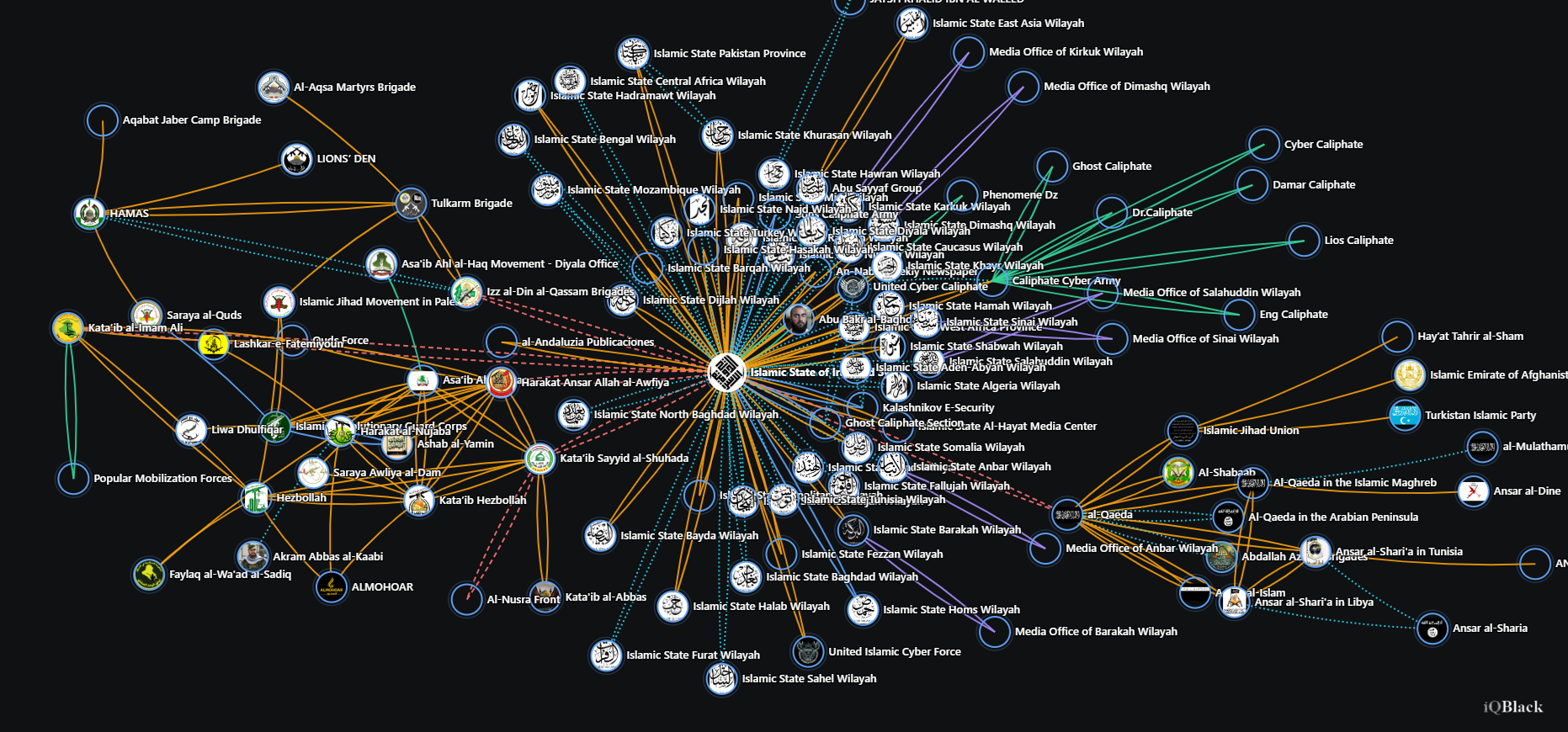
Relational map of the ecosystem associated with the Islamic State, based on linked profiles tracked by iQBlack in 2C-INT. The visualization reflects observed relationships, affinities, rivalries, or analytical associations between nodes, and does not by itself imply uniform hierarchical control or equivalent operational dependence across all actors represented.
In practice, the wilayah model now works as a hybrid system. The central brand retains symbolic validation, doctrinal continuity, and propaganda synchronization. Local branches, by contrast, tend to recruit, finance themselves, choose targets, and adapt to their environments according to the opportunities and constraints of each conflict setting. Reuters reported in 2026 that although Islamic State militants across multiple regions share ideology, there were no clear signs of systematic weapons or financing exchanges across theaters. That matters because it helps define the real nature of the system: coherent in identity, but unevenly integrated in logistics and command.
If viewed by region, the difference between the historic core and the active branches becomes even clearer.
In Syria and Iraq, the Islamic State remains a real threat, but it no longer plays the role of an expansive territorial center. The NCTC estimated in 2025 that ISIS still had between 1,500 and 3,000 members in Iraq and Syria, within a broader global network of roughly 8,800 to 13,100 members. In those two countries, the organization survives through clandestine cells, rural corridors, desert zones, detention ecosystems, and security vacuums that can reactivate when political crisis, institutional transition, or weakened state control converge. Reuters reported that after the fall of the Assad regime, Iraqi officials warned of the risk of ISIS reactivation in Syria, while security forces continued disrupting plots and monitoring insurgent movement.
That helps correct a simplistic perception: the Syria-Iraq core is not irrelevant, but neither is it the sole engine of the system today. Reasonable analytical inference: its current value appears to lie less in rigidly directing all branches and more in preserving historical legitimacy, ideological continuity, and regeneration potential. Basis for the inference: the core’s continued presence in official assessments, the UN’s characterization of the threat as “multipolar,” and the geographic displacement of much of the most intense violence toward other regions.
In Asia, the most important node is ISIS-K. Its relevance is not explained only by its presence in Afghanistan, but by its ability to project high-impact violence beyond its immediate environment. The January 2024 bombing in Kerman, Iran, and the March 2024 Crocus City Hall attack near Moscow established ISIS-K as the main reference point for external operations of high visibility. In 2026, the United Nations continued to treat it as one of the most serious branches because of its capacity for inspiration, facilitation, and attack.
If Asia illustrates the external-operations dimension, Africa now shows the depth of territorial adaptation and operational persistence within the movement. The Global Terrorism Index 2026 found that Islamic State and its affiliates remained the world’s deadliest terrorist group in 2025, operating in 15 countries, and highlighted a particularly severe deterioration in sub-Saharan Africa. The report also noted that the Sahel accounted for more than half of all terrorism deaths globally in 2025.
That geographic shift is not marginal. In the Lake Chad basin, Islamic State West Africa Province remains one of the system’s most important and most lethal branches. In Central Africa, activity linked to ISCAP and the ADF in eastern Congo continues to exploit weak state presence, war economies, and inadequate civilian protection. Reuters reported in 2025 and 2026 multiple massacres attributed to Islamic State-linked rebels in the Democratic Republic of the Congo, including attacks during funerals, in villages, and near health facilities.
In the Sahel and West Africa, the picture is more complicated because Islamic State-linked formations coexist and compete with organizations aligned with Al Qaeda. Even so, regional deterioration, porous borders, and weak state control are creating favorable conditions for several jihadist actors, including ISIS-linked branches. Reuters reported in 2025 that Islamic State-affiliated militants intensified attacks against civilians in western Niger, and in 2026 again recorded a sharp rise in incidents in the border area between Niger, Benin, and Nigeria.
So when asking where the ecosystem’s true operational center of gravity lies today, the most serious answer is probably not a single place. Rather, the system appears to distribute functions across several hubs. Syria and Iraq retain weight as historical origin, legitimacy source, and regeneration reserve. ISIS-K stands out as the main node for high-impact external projection. And several African branches concentrate a substantial share of lethality, informal territorial growth, and persistent activity on the ground. The system no longer depends on a single geographic heart. It depends on the interaction of multiple hubs serving different roles.
The relationship between local autonomy and brand coherence must be read within that framework. Not all affiliates display the same level of discipline, dependence, or capability. Some are deeply shaped by local criminal economies, communal rivalries, ethnic conflict, or specific cross-border dynamics. Others maintain a closer connection to the organization’s transnational narrative. But the Islamic State brand still offers something important: doctrinal legitimacy, international visibility, a shared story of continuity, and a propaganda apparatus capable of turning local violence into global psychological effect. That cohesive function remains relevant even when central operational control is uneven.
Reasonable analytical inference: the system’s present cohesion depends less on a uniform chain of command than on a mix of symbolic recognition, shared narrative, validation of belonging, and each branch’s ability to convert local conflict into relevance within a global identity. That helps explain why the Islamic State can remain strategically important even though none of its branches, on its own, reproduces the territorial model of 2014. Basis for the inference: persistence of the brand, operational divergence between theaters, institutional descriptions of the threat as “multipolar,” and the continued centrality of propaganda.
Geopolitically, this matters for several reasons. First, because it forces analysts to move beyond frameworks centered exclusively on Syria and Iraq. Second, because it shows that degrading or containing one branch does not amount to dismantling the system. Third, because the combination of locally adapted affiliates and a shared global identity makes the phenomenon harder to reduce to a single military campaign or one geography. And fourth, because detention systems, political transitions, security vacuums, and governance crises continue to function as especially favorable environments for regeneration. Reuters reported in 2026 on the transfer of thousands of ISIS detainees from Syria to Iraq after the detention environment in northeast Syria deteriorated, underscoring how prison management remains a strategic variable rather than merely a humanitarian or administrative issue.
The main public misperception, ultimately, is to keep asking whether the Islamic State has “returned” or “disappeared,” as if those two options were enough to describe its current condition. Neither is. What exists today is a more dispersed network, less dependent on a single territorial center, yet still capable of combining ideological legitimacy, local adaptation, persistent violence, and propaganda value under one banner. That does not amount to a linear return of the old caliphate. But neither does it amount to a marginal threat. It points to something more difficult: a system that learned how to survive by fragmenting without ceasing to recognize itself as part of the same project.
Reference
Note
This article was developed within iQBlack’s 2C-INT | Crime Characterization
for Intelligence analytical framework, designed for the structured
profiling of non-cyber actors, networks, and dynamics relevant to intelligence.
Actor
reference: Islamic State of Iraq and Syria
ID: 14277959090301062d10927c21ccff9899940
Explore 3C-INT
Expand actor, campaign and operational-link tracking through a structured intelligence layer.
Get new publications
Subscribe to receive new articles and public updates from iQBlack without unnecessary noise.