
Each time Cyber Islamic Resistance gains visibility, the same figure re-emerges at the center of that ecosystem. Sometimes as Abo Omar. Sometimes as TiTo. At other times through identities built around the Mhwear naming pattern. What matters is not only that he keeps appearing, but the kind of function his presence seems to serve. The more closely one looks, the less convincing it becomes to treat him as a merely decorative alias attached to propaganda messaging.
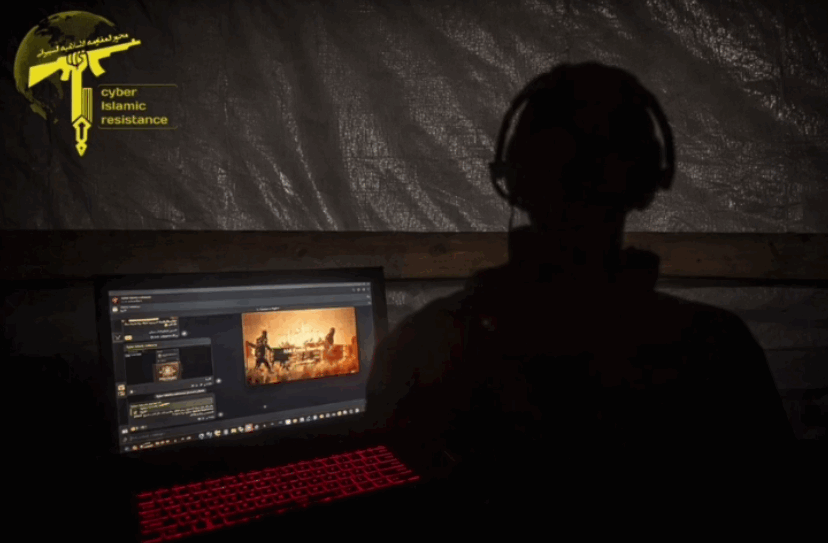
Still frame from a video attributed to Abo Omar and circulated within the Cyber Islamic Resistance communications environment. Rather than offering a conclusive personal identification, material of this kind helps illustrate how the ecosystem builds visible presence, symbolic authority, and continuity around a recurring public figure.
As this broader environment began to take shape and gain visibility, the most prudent way to read him was as a visible reference point of authority. A recognizable face inside a setting crowded with brands, channels, brigades, and resistance labels built around a strong propaganda logic. That reading still holds. But it now feels incomplete. Abo Omar appears to do more than simply represent a cause. He is beginning to look like a point of articulation inside an ecosystem where command does not always take classical forms, but where someone, or something, still helps keep the whole structure ordered.
That becomes clearer when one looks at the way he presents himself. He does not appear only as a spokesperson for Cyber Islamic Resistance. He also claims positions of command, founding, or momentum within the same environment: Islamic Resistance Axis, Holy League, October 7th Union, Electronic Conquerors Army, CyberStine Team, and Moroccan Black Cyber Army. Taken literally, that repertoire could sound inflated. Read with more context, it suggests something more interesting: he is not only trying to project strength, but to construct a trajectory. In effect, he is saying: I did not emerge from nowhere; I came from earlier phases, moved through other brands, helped build other structures, and still hold a place of reference within this space.
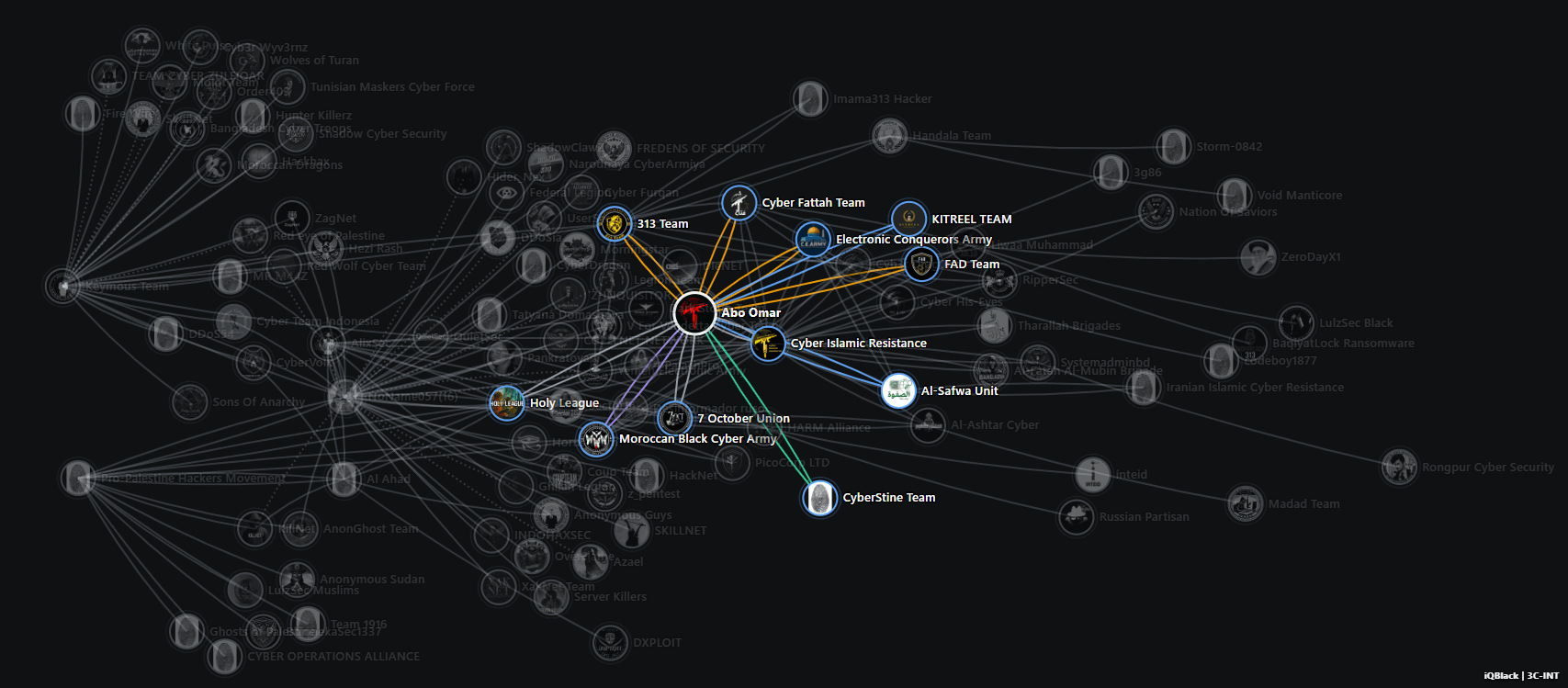
Relational map of the environment associated with Abo Omar inside the Cyber Islamic Resistance cluster. Highlighted links indicate first-degree relationships identified in the analysis, while shaded nodes help illustrate the wider breadth of the ecosystem. The visualization reflects observed proximities, associations, and layers of articulation, but does not by itself imply a uniform operational hierarchy across all represented actors.
That does not mean all of those entities should be treated as active, mature, and perfectly integrated organizations. That would impose too much neatness on an environment that does not appear to function neatly. Some of those labels likely point to earlier projects, some to recruitment fronts, some to propaganda wrappers, and some to more concrete layers of coordination. Even with that caution, the sequence matters. It sketches a possible genealogy of the cluster and suggests that Abo Omar does not want to be read as just another operator, but as someone positioned along a line of continuity linking different phases, names, and alliances.
This is where one of the keys to the analysis emerges. If Cyber Islamic Resistance can be read as a cluster that has absorbed groups and labels through ideological, political, and religious affinity, then Abo Omar begins to look less like the sole head of a closed organization and more like the point where several of those layers attempt to meet, recognize each other, and project a shared history. In such an environment, it would not be unusual for a visible identity to end up serving as a hinge. Not necessarily as the technical commander behind every operation, but as the figure that offers continuity, legitimacy, and a sense of belonging.
That also helps explain why his presence appears tied not only to ideological messaging, but to more concrete layers of the ecosystem as well: recruitment, calls for support, alliance language, brand continuity, contact channels, and funding. All of that seems to accumulate around the same orbit. And although there is still not enough basis to describe him as an operations chief in the classical sense, it is becoming increasingly reasonable to treat him as a probable coordinating figure within the cluster. He does not only speak in the name of the environment; he also appears to help keep it in motion.
That impression grows stronger once the support layer enters the picture. In this ecosystem, fundraising and ideology do not run on separate tracks. Appeals for support are not framed as administrative needs or secondary logistics, but as part of the resistance narrative itself — sustaining infrastructure, protecting communications, reinforcing continuity, and resisting censorship. From an intelligence perspective, that detail changes the reading because his weight stops being merely symbolic. The fact that Abo Omar solicits donations through specific channels does not prove personal enrichment or a criminal economy in the strict sense. But it does suggest that the ecosystem around him is not moved by ideology alone; it also thinks in terms of infrastructure, continuity, and sustainment.
It is also worth looking at how this environment imagines its own capabilities. Around Abo Omar appear brigades, functions, specializations, calls for specific profiles, and a way of segmenting tasks that ranges from distributed denial-of-service attacks and target reconnaissance to social engineering, tool development, and training. Part of that may be aspirational. Part may be pure propaganda architecture. Even so, it remains revealing. It shows how this environment wants to be seen both internally and externally: not as a simple sum of angry channels, but as a layered structure with specialization, room for growth, and material support. And once again, the figure at the center of that image is the same one.
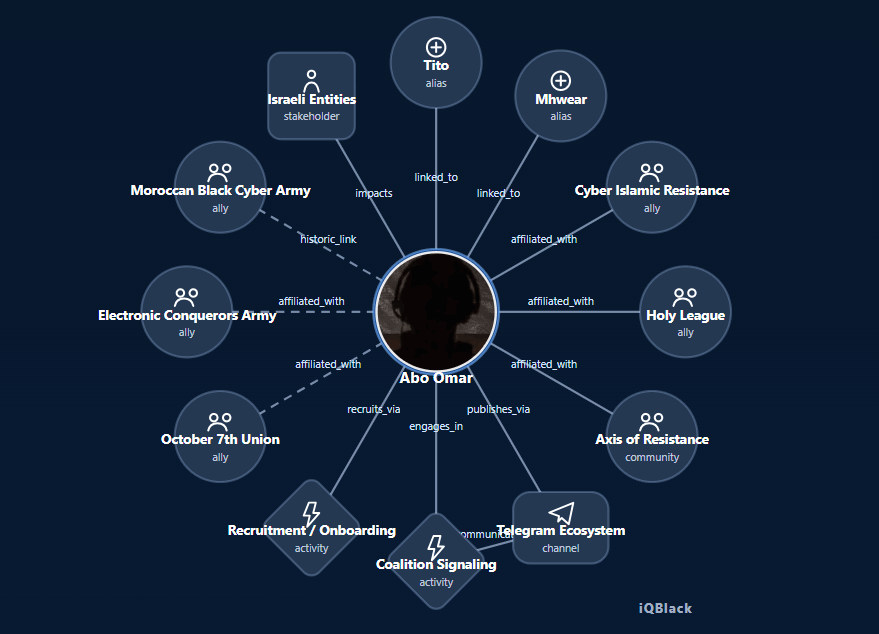
Network and activity diagram associated with the Cyber Islamic Resistance ecosystem. The visualization brings together the interaction between identity, recruitment, alliances, propaganda, support, and operational projection around key figures and brands within the cluster, offering a structural reading of the environment beyond any single claim.
That is why the most useful question may not be whether Abo Omar exists as a perfectly resolved individual, but what kind of problem his figure organizes within the cluster. And for now, the answer seems fairly clear. He helps order a genealogy. He helps connect brands. He helps provide a point of reference for recruitment, support collection, alliance maintenance, and continuity projection.
Seen from that angle, Abo Omar embodies more than symbolic authority. He also seems to condense something harder to manufacture: the sense that behind the noise there is an underlying will to organize. That may be one of the strongest reasons his figure deserves attention in threat research. Not because it fully resolves a person, but because it helps illuminate the way Cyber Islamic Resistance and its associated environment build cohesion and project capability in the digital space.
This reading of Abo Omar’s role within the Cyber Islamic Resistance framework also connects naturally with the earlier analysis that described the group as a social and strategic infrastructure of hybrid warfare. If that earlier article helped explain the cluster’s broader logic, Abo Omar helps bring one of its most delicate components into view: the way that environment organizes authority, sustains continuity, and projects command.
Methodological note: This analysis draws on internal profiling inputs developed in 3C-INT on Cyber Islamic Resistance and its surrounding ecosystem of associated brands, figures, and structures.
Explore 3C-INT
Expand actor, campaign and operational-link tracking through a structured intelligence layer.
Get new publications
Subscribe to receive new articles and public updates from iQBlack without unnecessary noise.