
Executive Summary
Handala recently released an audiovisual piece that presents, in visual summary format, alleged operations, exposure of targets, and messages associated with its activity against Israeli interests. The piece should not be treated as conclusive technical evidence of each operation shown, but as a propaganda product designed to project capability and reach.
The video combines a war-room aesthetic, technical-looking interfaces, references to leaks, alleged access, exposed data, and identifiable targets. That combination aims to organize a narrative of persistence, exposure, and psychological pressure.
From an intelligence perspective, the relevant element is not only what the video claims, but how it presents it. The piece shows how certain hacktivist actors can use advanced editing, AI-assisted aesthetics, and audiovisual resources to turn attributed activity into a message that is easier to circulate, interpret, and replicate.
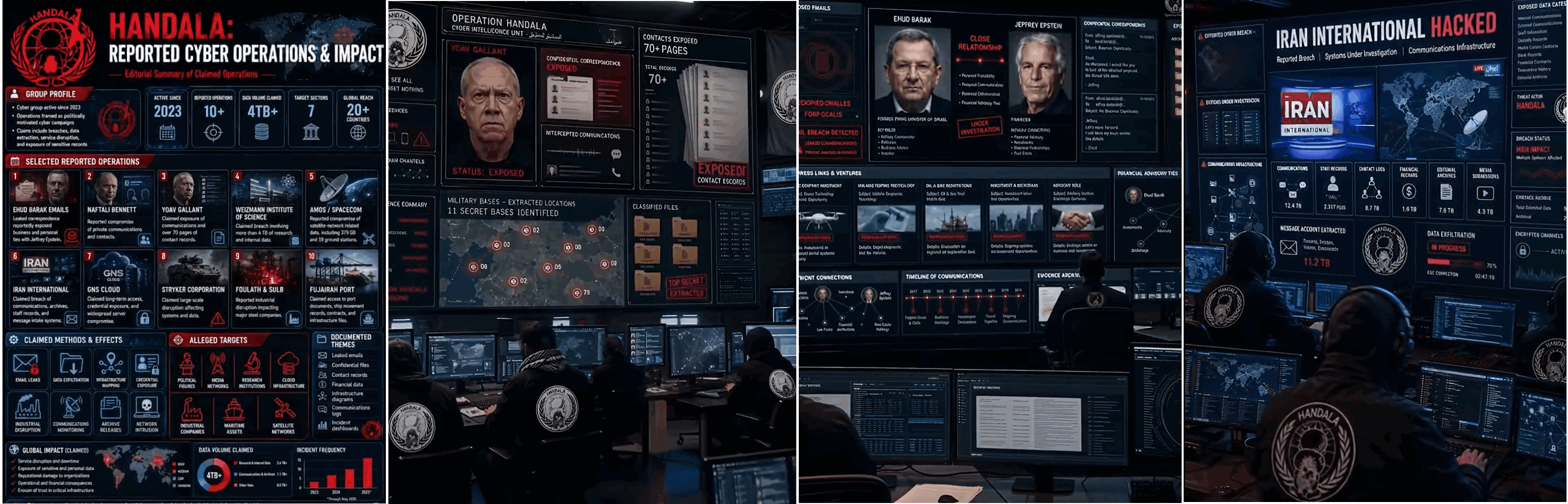
Selected captures from the audiovisual material released by Handala. The piece uses a war-room aesthetic, impact dashboards, alleged targets, and references to exposed information to project capability, reach, and continuity. The image is included as visual evidence of the propaganda format analyzed, not as technical validation of the operations represented.
Key Judgments
- Handala uses a high-production visual narrative to package alleged operations, exposure of targets, and signals of persistence.
- The material’s aesthetic seeks to project organization and reach, even while technical verification of each claim remains pending.
- The republication of this type of material by third parties may operate as involuntary amplification of the actor’s propaganda if it is not accompanied by analytical context.
What Happened
Handala published an audiovisual piece aimed at summarizing activity attributed to the actor. The material shows a succession of scenes with an intelligence-operation aesthetic, analysis screens, references to alleged targets, exposed data, infrastructure, documents, and messages associated with previous or recent campaigns.
The piece does not present itself as a traditional technical report. Its visual language is closer to a propaganda production: fast pacing, cinematic composition, a sense of operational dashboard, and the use of graphic elements designed to transmit control, access, and continuity.
A contact or interaction layer also appears, associated with bot-style channels or communication mechanisms with the actor. This component may function as a resource for recruitment, information intake, community building, or simple narrative reinforcement. With the available evidence, it does not allow confirmation of an effective recruitment or contact operation, but it does add a social dimension to the piece.
Operational Assessment
This type of material serves several functions at the same time: it organizes dispersed activity into a coherent story, turns alleged access or leaks into signals of continuity, applies psychological pressure on target audiences, and gives sympathizers, followers, or third parties a piece that is easy to share.
AI-assisted aesthetics or advanced editing reinforces that effect. Actors that previously depended on banners, screenshots, or short communiqués can now produce audiovisual pieces with a professional appearance, low cost, and high visual impact. This does not necessarily increase their technical capability, but it may improve their ability to present activity, sustain attention, and reinforce reputation.
Handala does not demonstrate more simply because the video looks more sophisticated. What it does show is an improvement in the way it orders and distributes its narrative. In psychological warfare, that layer may be enough to generate attention, anxiety, and propagandistic effect.
Intelligence Significance
The piece points to the visual professionalization of hacktivist propaganda. Actors do not compete only for access, leaks, or service disruptions. They also compete for perception, legitimacy, presence, and circulation capacity.
In that scenario, a high-impact video can work as a multiplier. If third parties republish it without critical distance, even with informative intent, they may end up expanding the reach of the actor’s narrative. This does not mean the material should be ignored, but it does need to be contextualized: what it claims, what it shows, what it does not prove, and what it seeks to produce in the audience.
For iQBlack, the interest of the case lies in the actor’s communicational evolution. Handala appears to be using more elaborate audiovisual formats to consolidate an image of persistence and reach. If this practice becomes recurrent, it may mark a shift in how certain hacktivist actors present attributed activity and seek public validation.
iqAnalytical Closing
Handala’s video should not be interpreted as automatic validation of the operations it presents. Its intelligence value lies elsewhere: it shows how a hacktivist actor can transform public claims, symbols, alleged access, and contact messages into a piece of psychological pressure ready to circulate. The threat is not only in what the actor may have done technically, but also in its ability to turn perception into effect. In that terrain, audiovisual propaganda is becoming an increasingly relevant layer of digital conflict.
Explore 3C-INT
Expand actor, campaign and operational-link tracking through a structured intelligence layer.
Get new publications
Subscribe to receive new articles and public updates from iQBlack without unnecessary noise.