
Executive Summary
Hezbollah Electronic published a new visual and narrative propaganda piece focused on the economic cost that the war with Iran would be generating for U.S. consumers. The message uses a reference attributed to The Wall Street Journal regarding an additional USD 45 billion in gasoline spending during the conflict.
The actor uses this information and turns it into a political reading with a propagandistic dimension, connecting war, energy, inflation, social unrest, and the U.S.-Israel relationship within a single psychological pressure narrative. The message is oriented around the idea that the U.S. citizen is paying the cost of a war presented as favorable to Israel.
The associated image, which accompanies this narrative, reinforces the message through a highly symbolic visual composition: a citizen refueling a vehicle, a bomb/rocket carrying an Israeli insignia, a gas station marked with the U.S. flag, and an industrial background in flames. The objective is not to inform, but to condense a political idea into a fast-impact scene.
Key Judgments
- Hezbollah Electronic uses a real or publicly reported economic signal to build an anti-U.S. and anti-Israeli narrative.
- The publication targets the U.S. citizen as an indirect economic victim of the conflict, not technical infrastructure.
- The piece reinforces a propaganda line based on domestic costs, energy, regional war, and the Washington-Tel Aviv alliance.
- The image shows a level of visual production above the average hacktivist standard, but consistent with the propaganda style of terrorist organizations, designed for rapid circulation.
What Happened
Hezbollah Electronic published a visual piece accompanied by an Arabic-language message titled, in approximate translation, “The bill for the Israeli adventure: the American citizen pays the price of Netanyahu’s wars.”
The text cites The Wall Street Journal to state that the war with Iran would have generated an additional USD 45 billion in gasoline spending. From that figure, the actor builds a political reading intended to implant the message that the gains go to Tel Aviv, while the cost falls on Washington and the U.S. taxpayer.
The publication was accompanied by hashtags linked to Iran, the promise of retaliation, the defense of Lebanon, and narratives associated with the Axis of Resistance.
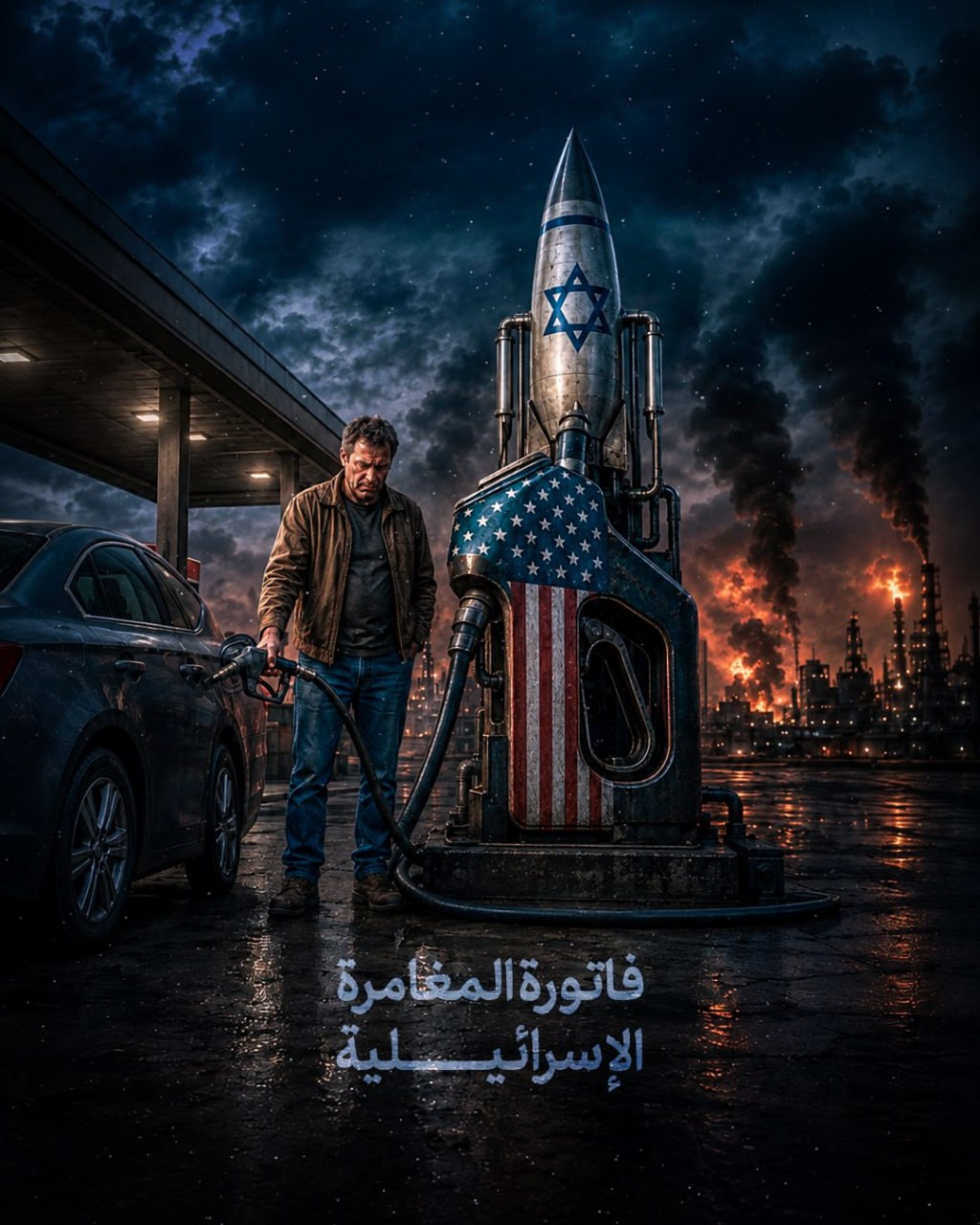
Visual propaganda disseminated by Hezbollah Electronic linking the increase in energy costs for U.S. consumers with the Iran-Israel war and the narrative of Washington’s support for Tel Aviv.
Operational Assessment
The publication shows a communication campaign with strategic value in which Hezbollah Electronic takes a sensitive economic figure, connects it with the war, and then translates it into a high-impact image.
The message seeks to conduct psychological action against a social vulnerability represented domestically by economic fatigue, fuel prices, and the perception that external conflicts generate internal costs. Its narrative installs the idea that the U.S. citizen is financing someone else’s war.
Intelligence Significance
Hezbollah Electronic is not merely accompanying propaganda campaigns with generic ideological messages; it is seeking to leverage economic data and current events to produce narratives aimed at broader audiences.
The piece also shows how actors within the pro-Iran / Axis of Resistance ecosystem can exploit Western media publications to reinforce their own propaganda frames. The economic figure works as a starting point, and the final narrative turns that figure into a political accusation.
For iQBlack, the relevant signal lies in economic pressure and professionalized visual propaganda, consistent with the sensationalist propaganda of Middle Eastern terrorist organizations. The objective of this type of campaign is usually to implant perceptions of exhaustion, social cost, and loss of political control in adversary countries.
Analytical Closing
Hezbollah Electronic’s publication shows how the actor transforms the energy cost of war into a simple narrative, visually reinforced with a high-impact emotional charge and sustained by the Axis of Resistance narrative.
Explore 3C-INT
Expand actor, campaign and operational-link tracking through a structured intelligence layer.
Get new publications
Subscribe to receive new articles and public updates from iQBlack without unnecessary noise.