
Executive Summary
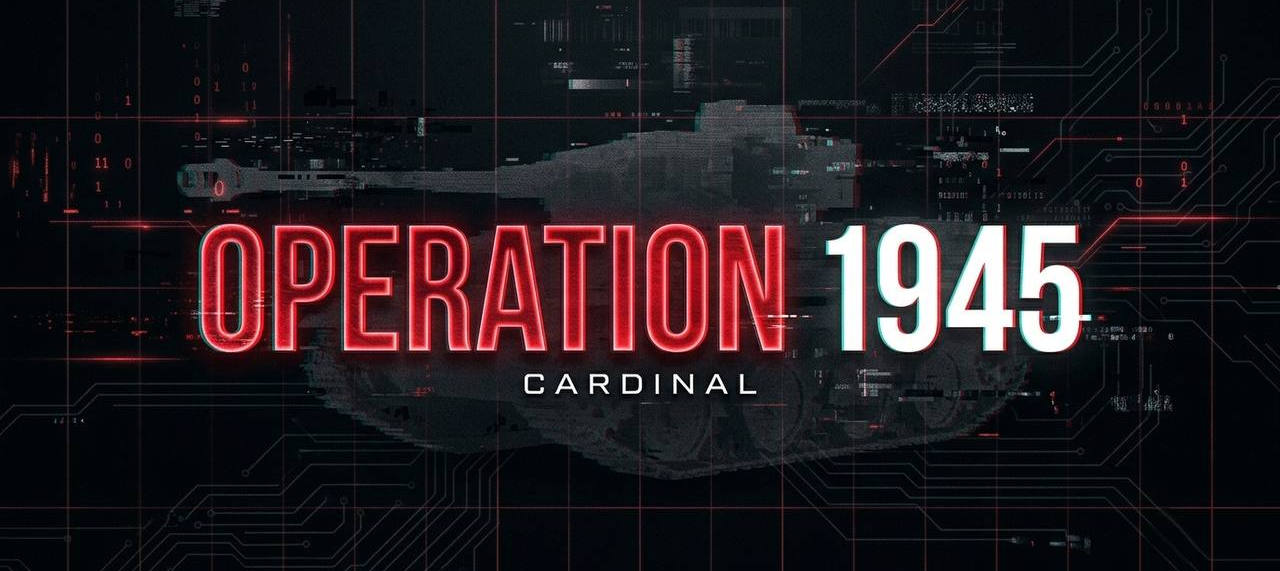
Cardinal Hackers announced the launch of an operation named “1945”, directed against the German government. The statement presents the action as a response to Germany’s political and military support for Ukraine and explicitly seeks to separate the German people from their authorities.
The message does not identify specific technical targets, does not include evidence of unauthorized access and does not provide samples, documents or verifiable indicators. However, its relevance lies in the use of a historical and political narrative designed to exert pressure on the German government and contest public perception of the war in Ukraine.
The choice of the name “1945” carries evident symbolic weight. Cardinal appeals to German historical memory, the end of the Second World War and the Russian narrative of anti-fascist victory to frame the operation as a warning against Germany’s alignment with Ukraine and the United States.
Key Judgments
- Cardinal declares a named operation against the German government, but does not present technical evidence confirming intrusive activity.
- The message seeks to differentiate between the German people and their authorities, a common narrative-pressure technique aimed at eroding internal legitimacy.
- The operation fits within a pro-Russian narrative that portrays German support for Ukraine as subordination to Washington and Kyiv.
- The use of “1945” reinforces the symbolic weight of the announcement and connects the operation with historically sensitive references for Germany and Russia.
- The publication suggests continuity in Cardinal’s use of named operations to project capability, set an agenda and prepare audiences for possible subsequent actions.
What Happened
Cardinal published a statement announcing the launch of Operation 1945 against the German government.
The actor states that the operation is not directed against German society, but against those who, according to its narrative, are leading the country into a war that does not belong to it. The text accuses the German government of sending weapons to Ukraine, funding the conflict through taxes, promoting a hostile view of Russia and silencing critical voices.
The publication uses a warning formula aimed at “waking up” the German population. Rather than presenting the operation as a direct aggression against citizens, Cardinal frames it as a corrective action against a political elite allegedly subordinated to Washington and Kyiv.
Operational Assessment
At this stage, iQBlack assesses Operation 1945 as an active campaign declaration. The piece has a primarily communicational function through which Cardinal opens a narrative front against Germany by means of an operation with an explicit state-level target and deliberate historical weight.
The distinction between “people” and “government” is central to the message. Cardinal seeks to install the idea that its adversary is not Germany as a society, but a political leadership that, in the actor’s framing, has betrayed national interests by aligning with Ukraine and the United States.
The name “1945” reinforces that framing by referring to a highly sensitive historical point. It allows the actor to insert the operation into a narrative of memory, guilt, the defeat of Nazism and Russian legitimacy, functioning as a tool of symbolic pressure.
Cardinal has recently used named operations to announce actions against state-level or high-political-value targets. In this context, Operation 1945 represents continuity in a visibility strategy based on named campaigns, geopolitical signaling and the promise of future activity.
Intelligence Significance
The relevance of Operation 1945 does not depend solely on whether immediate intrusions materialize. The announcement shows how Cardinal uses hacktivist language to intervene in a broader political dispute involving Germany, Ukraine, the United States and Russia. The operation seeks to generate information pressure, contest public narratives and position the actor as another vehicle of pro-Russian retaliation.
If defacements, DDoS attacks, data leaks or other documentary publications linked to the operation appear in the coming days, 1945 could consolidate as a meaningful indicator of activity against German entities.
If no verifiable technical evidence appears, the publication will remain relevant as an indicator of intent and as an indicator of how Cardinal attempts to capitalize on historical symbols to reinforce its positioning within the pro-Russian hacktivist ecosystem.
Analytical Closing
Cardinal uses Operation 1945 to announce an action against the German government and project a narrative of political pressure based on historical memory, opposition to support for Ukraine and confrontation with the United States.
Until technical or documentary evidence becomes available for verification, iQBlack assesses the publication as a preliminary campaign indicator and not as confirmation of an effective intrusion. Its immediate value for cyber intelligence lies in the signal of intent and Cardinal’s propagandistic framework in the use of named operations against state-level targets.
Explore 3C-INT
Expand actor, campaign and operational-link tracking through a structured intelligence layer.
Get new publications
Subscribe to receive new articles and public updates from iQBlack without unnecessary noise.